
Hear this, America…
“Therefore I still contend with you, declares the Lord,and with your children’s children I will contend.
For cross to the coasts of Cyprus and see, or send to Kedar and examine with care; see if there has been such a thing. Has a nation changed its gods, even though they are no gods?
But my people have changed their glory for that which does not profit.
Be appalled, O heavens, at this; be shocked, be utterly desolate, declares the Lord,
“for my people have committed two evils:
they have forsaken me, the fountain of living waters,
and hewed out cisterns for themselves,
broken cisterns that can hold no water.”
Jeremiah 2:9-13

The situation in America and across the globe today is similar and deteriorating rapidly.
My heart breaks as it seems many of our churches are weak and vacillating – few take seriously the Word of God and ignore most Bible prophecy. Many seem to read from a redacted Bible and re-write Scripture to feel more comfortable with – that which fits your preconceived ideas, and ignore the rest.

But, be warned,
Wherever the Word of God is hidden or ignored, there will be certain destruction.
Do not be deceived: God cannot be mocked. A man reaps what he sows. [Galatians 6:7]
Partly because the priests in Israel had failed to teach God’s Word to the people, Israel suffered. There was no faithfulness, no love, and no acknowledgment of God in the land. Rather there was only cursing, lying, murder, stealing and adultery.
Sound familiar, America?
Like in ancient Israel, the problem in America today is the people are guilty of forsaking God and attempting to create their own paths to heaven with broken cisterns.
 I think the Greek philosopher Plato understood the plight of those building broken cisterns long ago. I encourage you to read Platos’ Allegory of the Cave.
You will see why few people know what truth is anymore, instead replacing fact with feeling on the altar of relativism and ridiculing anyone who claims to have truth. When presented with objective truth, you postmodernist naysayers throw up your arms and refuse to even listen anymore.
When people hear there is a reality beyond the dancing shadows on the wall, they are offended because that’s the only life they know and love. Like in Platos Allegory, the prisoners will turn on their rescuers to kill them… to shut them up and let them get back to their shadows on the wall.
Jesus confronted the religious leaders of His day regarding their hypocrisy and following the dancing shadows on the wall (man’s traditions) instead of God…
And the Pharisees and the scribes asked him, “Why do your disciples not walk according to the tradition of the elders, but eat with defiled hands?” And he said to them, “Well did Isaiah prophesy of you hypocrites, as it is written, “‘This people honors me with their lips, but their heart is far from me; in vain do they worship me, teaching as doctrines the commandments of men.’ You leave the commandment of God and hold to the tradition of men.” – Mark 7:5-8

It’s as if somehow man’s traditions, intellect, or dancing shadows somehow usurps God’s Word. We might look back at those early times and wonder why those people could not see the error of their ways, when in fact, the same hypocrisy exists in many of our churches even today. Consider some of the traditions you are holding on to and how you are rationalizing them by twisting scripture in contradiction to God’s Word to fit your comfort zone. Are we not guilty of the same sin of those Pharisees and scribes?
This is the verdict: Light has come into the world, but men loved darkness instead of light because their deeds were evil. Everyone who does evil hates the light, and will not come into the light for fear that his deeds will be exposed. But whoever lives by the truth comes into the light, so that it may be seen plainly that what he has done has been done through God. [John 3:19-21]
My heart breaks when I think of those whose family members and those close to them live in darkness. And, what about all those people filling the pews in our churches on Sunday that live carnal lives the rest of the week. Scripture would suggest that is because they do not want their evil deeds done in darkness to be exposed. I’m not suggesting any of us can be sinless, for all have sinned and fall short of the glory of God, – Romans 3:23
Others may feel they are beyond redemption or are unworthy and don’t deserve God’s love for whatever reason. That, too, is a lie from the pit of hell.
There is forgiveness for all our sins if you simply ask for it.
What I am suggesting is that we can humbly acknowledge our sin, repent of those sins, and seek God’s way instead of our own (2 Chronicles 7:14). Sadly, most people today love the darkness and do not want to come into the light (truth). As most Americans are now living in darkness and refuse the truth, their consciences have been seared and like the brazen prostitute; they refuse to blush with shame (Jeremiah 3).
A mass psychosis has infected our world and spread throughout the world turning people’s lives upside down and their minds to mush.

As the facts unfold, it’s becoming increasingly clear recent crisis are manufactured by globalist anti-Christian elites intending to promote their new world order agenda of control and domination of society.
One thing is abundantly clear. You are being played. You are being lied to by the government, the military industrial complex, the medical industrial complex, public health officials, the media, politicians, and yes even our pulpits.
The Bible tells us, “My people are destroyed from lack of knowledge.” (Hosea 4:6).
I’m appalled by the lack of intelligence many people have about the world they live in and their acceptance of critical information being censored in the mass media. They are left uninformed, misinformed, confused and afraid. I don’t believe any of this nonsense is coincidental, it’s all part of the admitted new world order plan to control and dominate you – and that’s why I’m speaking up about it.
We are witnessing in our lifetime Satan’s attempt to take the saints captive [Revelation 13:10].

And, he is not content with only the lost already living in darkness… it’s the light he wants to extinguish: the Church and the Word of God.
George Orwell wrote of one of Satan’s strategies over 70 years ago. He called it doublethink and the language as doublespeak. A good example are social media platforms like Facebook, Twitter, YouTube, and others attempting to silence voices exposing the deeds of darkness.
What’s their rationale? Protecting their users from “hate speech”. In their perverted minds, God’s Word is hate speech and it must be eradicated. God help us!
Woe to those who call evil good and good evil, who put darkness for light and light for darkness, who put bitter for sweet and sweet for bitter. [Isaiah 5:20]
WAKE UP Christian!

Some people are quick to blame leftist politicians for the world’s problems and suggest there are political solutions to Make American Great Again.
But, there are no political solutions for our spiritual problems.
Let me say that again…
There are NO political solutions for our spiritual problems.
We will not overcome Satan or his lies at the ballot box. That is one of our broken cisterns that we’ve got to abandon because it holds nothing. As we continue building these broken cisterns for ourselves and joining together with others building their broken cisterns… everything we know will continue falling apart.
If my people, which are called by my name, shall humble themselves, and pray, and seek my face, and turn from their wicked ways; then will I hear from heaven, and will forgive their sin, and will heal their land. – 2 Chronicles 7:14
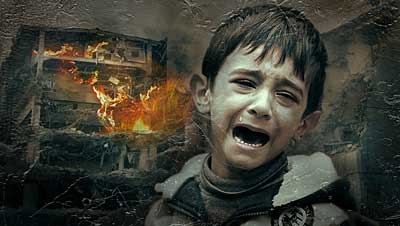 Why are there people who walk among us that have no empathy for others resulting in violence and bloodshed?
- Why are kids pulling out guns and shooting others?
- Why are our governments and prominent business leaders steeped in greed, corruption, and now we’re learning… pedophilia?
- Why is there so much evil in our land?
- If God is love and God is all powerful, why does He allow suffering in the world?
Because we have not heeded the words of 2 Chronicles 7:14.
These broken cisterns we’ve built for ourselves have not worked and the situation will only get worse. Covering over the cracks with good intentions, more laws, and whatever else you’re using to put lipstick on the pig simply ain’t gonna work.
More violence and insanity is coming to your workplace, your schools, your place of worship, your streets and towns, and yes even into your home.

The grand experiment in freedom called America is crumbling before our eyes as we are allowing the anti-God forces of collectivism to creep in to every part of society. Our founders must be turning over in their graves as the vast majority of Americans are accepting this antichrist agenda – and yes, that includes most of the so-called Christian churches in America.
Just as the alcoholic will not accept his sickness until hitting bottom, it would appear our society has not yet hit bottom as we continue in our degeneration.
Mark my words… you may have a comfortable life today, but that is all about to change, and believe me… it’s not pretty. And, there’s nobody to blame but ourselves.
It doesn’t have to be that way though.
But, we must first get our own house in order and get right with God.
- We’ve got to humble ourselves,
- We’ve got to pray,
- We’ve got to seek God’s face, and
- We’ve got to (repent) turn from our wicked ways
.
In the meantime, if we continue this path we’re presently on… God will judge.. We will suffer in the mayhem and destruction of everything we know. And… your broken cisterns won’t help you.
So, What Is The Solution?
Quite simple… Jesus Christ (Yeshua)
Jesus answered, “I am the way and the truth and the life. No one comes to the Father except through me.” – John 14:6
You want to know the truth?
You can if you choose to.
You will if you hold to (follow, continue to obey) Christ’s teaching.
It will set you free.
Jesus said, “If you hold to my teaching, you are really my disciples. Then you will know the truth, and the truth will set you free.” – John 8:31-32
If you are to make any sense out of what is happening in our decaying world today, you need to have truth backed up with knowledge and understanding (Hosea 4:6) of Bible prophecy, end times, history, world events, and the strategies Satan uses to enslave people. Once you understand the root of our problem, you’ll better understand the solution.
What is truth?, you might ask.

The satanic cultural marxist inspired lie of “Tolerance” – where God’s Word is not proclaimed because people fear insulting or offending others has so infiltrated America today that few people even recognize the destructive results that inevitably follow. These people do not understand what God says in prophetic Scripture and do not believe they will be judged for their disbelief.
If you’re one who has redefined sin using the tolerance yardstick, I guarantee you won’t like what you read here on the Jeremiah Project. I don’t claim to be politically correct, nor will I attempt to be so. You may likely be offended by what you believe to be a narrow-minded, hate-filled, and intolerant viewpoint.
Praise God! That means your conscience may still be intact.
The fear of the LORD is the beginning of wisdom; all who follow his precepts have good understanding. – Ps 111:10
Those with good understanding of God‘s Word will follow God’s commandments.
Those who do NOT obey God and keep ALL His commandments have a poor and incomplete understanding of Scripture. If you understand God’s law and do not obey, you are still accountable for your actions.
 Many today have replaced God’s Law with the laws of man, not too unlike the Pharisees of Jesus’ time. There are blessings for us today when we follow His law and there are curses for us today when we don’t (Deuteronomy 28). Spend some time and read Deuteronomy 4 through 30. It explains the blessings we can expect when we follow God’s commands and the explicit curses that will befall us when we reject His commands.
I’ve heard people ask, “If God is a loving God, why does He permit the suffering we see in our world today?” That question is clearly answered in Deuteronomy 28.
I am not suggesting that you are “saved” by following God’s commandments (Mosaic Law) or that you are condemned by not following them (that would be a salvation by “works”). Thankfully, if you have accepted Christ as your Savior, your salvation is assured and guaranteed by the presence of the Holy Spirit in your life.
Therefore no one will be declared righteous in his sight by observing the law; rather, through the law we become conscious of sin. – Romans 3:20

But, I do believe the law exposes our sin and does not shield us from the consequences of our actions. It’s not your eternal salvation in question here… but it’s the outcomes you experience in this life.
God does NOT want to bring judgement on America,
or anybody in the world for that matter.
He has a better plan.
“For I know the thoughts that I think toward you, saith the LORD, thoughts of peace, and not of evil, to give you an expected end.”- Jeremiah 29:11
 Alexander Hamilton once described America as a “grand experiment” and I believe God inspired the founders of America as they set up this country we now call the United States of America. The founders enshrined their belief in God in the founding documents of America and strove to honor His word in our Constitution. The people were blessed and we witnessed the birth and growth of what was to become the greatest modern day country on the face of the earth.
This sentiment was captured in the patriotic song written by Katharine Lee Bates in 1893, “America the Beautiful”.
O beautiful for spacious skies,
For amber waves of grain,
For purple mountain majesties
Above the fruited plain!
America! America!
God shed his grace on thee
And crown thy good with brotherhood
From sea to shining sea!
Wake up Christians!
And do this, understanding the present time. The hour has come for you to wake up from your slumber, because our salvation is nearer now than when we first believed. – Romans 13:11

Things That Matter
There are some who might criticize some of my articles because they focus on issues of politics, modern culture, and recently Coronavirus. But, I say these are things that matter and have a spiritual dimension to them.
Jeremiah recognized the link and was criticized for it.
John the Baptist was not silenced by the politics of his day and lost his head [Matthew 14].
Even Jesus stood up to the political powers of the day speaking truth to power, calling the political elite of His day a “brood of vipers.” [Matthew 12]
Religion that God our Father accepts as pure and faultless is this: to look after orphans and widows in their distress and to keep oneself from being polluted by the world. – James 1:27
 Many of the political issues of our day are inextricably linked to our Christian faith.
How we look after orphans and widows is reflected in our politics as is our viewpoint of the world we live in and the interactions we have with others around us. When we allow the dark forces of evil to prevail in our politics, that will affect us and we will suffer in our faith.
Instead, we must stand firm on the Word of God and speak truth to power.
“If anyone has material possessions and sees his brother in need but has no pity on him, how can the love of God be in him? Dear children, let us not love with words or tongue but with actions and in truth.” – 1 John 3:17-18
“Our lives begin to end the day we become silent about things that matter.” – Martin Luther King Jr.
God tells us in Psalm 50 that He will not tolerate hypocrisy and will judge the wicked. There is a day of reckoning coming. When we are passively indifferent and remain silent about the evil in our society, we are in effect joining the wickedness and are as guilty as the perpetrators of the crime (see v. 18).
But to the wicked, God says: “What right have you to recite my laws or take my covenant on your lips? You hate my instruction and cast my words behind you. When you see a thief, you join with him; you throw in your lot with adulterers. You use your mouth for evil and harness your tongue to deceit. You speak continually against your brother and slander your own mother’s son. These things you have done and I kept silent; you thought I was altogether like you. But I will rebuke you and accuse you to your face. [Psalm 50:16-21]
“Hypocrisy is wickedness, which God will judge. And it is too common, for those who declare the Lord’s statutes to others, to live in disobedience to them themselves. This delusion arises from the abuse of God’s long-suffering, and a wilful mistake of his character and the intention of his gospel. The sins of sinners will be fully proved on them in the judgment of the great day.” [Matthew Henry’s Concise Commentary]

If consenting with or agreeing with the thief is wicked, how much more wicked is it to support and defend unbiblical laws?
Many churchgoers claim a form of religiosity or churchianity (their own cisterns), yet the Scripture is closed to them. They do not understand. Their pulpits are silent about things that matter, and some even promote the apostacy. For them, Christianity is just organized paganism. Look at many of the images, the rituals, and holidays of the church today. Paganism cloaked in Christianity.
We must not be like the good German Christians who stood by in their churches as millions of Jews were hauled off to concentration camps to be used as slave labor and killed. Unlike them, we can stand up and say, ENOUGH… NO MORE and fulfill our calling from Christ to love our neighbor.
It is time, indeed past time, for Christians to stand up and resist the satanic tyranny leading many to destruction. You must not remain silent any longer! Neutrality is synonymous with consent and will be judged by God. Wake Up!
There’s a time when the operation of the machine becomes so odious, makes you so sick at heart that you can’t take part! You can’t even passively take part! And you’ve got to put your bodies upon the gears and upon the wheels, upon the levers, upon all the apparatus — and you’ve got to make it stop! And you’ve got to indicate to the people who run it, to the people who own it — that unless you’re free the machine will be prevented from working at all.” – Mario Savio
God is Speaking to us Today through Bible Prophecy

If you have ears to hear and eyes to see, God is speaking to you through His prophets and the words contained in Bible Prophecy.
 He is calling out to His chosen people to be a holy remnant faithful to Him and His calling. He has given us the owners manual, if you will, and told us how life will be when we follow it. We don’t need to be overcome by fear or dread of the enemy because Jesus has already conquered the enemy. Jesus only asks us to, “Take up your cross and follow Me”.
Just as God spoke to His people through the prophet Jeremiah in 608 BC, I believe His words are as relevant today as they were then…
Thus says the LORD, “If you will not listen to Me, to walk in My law which I have set before you, to listen to the words of My servants the prophets, whom I have been sending to you again and again, but you have not listened; then I will make this house like Shiloh, and this city I will make a curse to all the nations of the earth.” – Jeremiah 26:4-6
The rest is history, as they say.
Domination, destruction, and slavery.
Why?
And when the people ask, “Why has the Lord our God done all this to us?” you will tell them, “As you have forsaken me and served foreign gods in your own land, so now you will serve foreigners in a land not your own.” – Jeremiah 5:19
They did not hallow God’s name, His decrees and judgments. Instead, they allowed their community to become desecrated with foreign gods and dug their own cisterns in their own way. I believe we stand again at the precipice of God’s judgment today as the Church is once again being invaded by foreign gods and Christians are busy digging their own cisterns.
The results, too, will be the same… domination, destruction, and slavery.
Or… we can choose God.
If my people, who are called by my name, will humble themselves and pray and seek my face and turn from their wicked ways, then will I hear from heaven and will forgive their sin and will heal their land. [2 Chronicles 7:14]